By Tom Ayres, Vermont Standard Senior Staff Writer
An iconic Vermont barn on the Moore family farmstead in Pomfret has remained chock full of the tools, materials, and ephemera of master craftsman David Moore’s trade for the better part of 60 years.
Parts of disassembled pipe organs have filled the shelves throughout the sprawling barn for those six decades — an antique black cherry organ casing on one stack of shelves, together with its massive pipes, keys, and inner workings here and another renovation work-in-progress there: an enormous J.W. Steele Opus 1 pipe organ, built in 1867, and destined for St. Matthew’s Church in Newport Beach, California, where it was reassembled and installed in the Anglican Catholic Church just nine months ago — one of the last of scores of pipe organs that Moore restored, rebuilt, and built over the course of his extraordinary life.
David Moore was the organ minder.
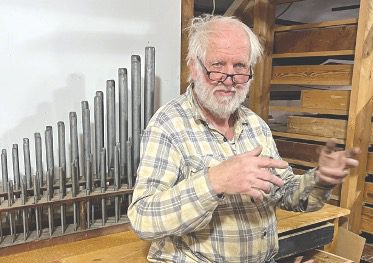
David Moore always took the time to explain the intricacies of pipe organ restoration, rebuilding, and maintenance whenever people visited his Pomfret workshop and studio during the course of his 50-plus years in business. Tom Ayres Photo
Raised on the family farm in Pomfret, Moore had a fascination with wood and mechanical objects from an early age: when his older brother John and younger sibling Emily asked for toys or games at Christmas time, Moore always sought after tools, wood, or things he could build or disassemble and build anew. He learned to play the piano and enjoyed making music as well. Together with his school chum and friend of nearly 70 years, John Atwood, Moore rebuilt a battered, nonfunctioning pipe organ that the pair were gifted by Max Spaulding and other members of the Masonic Hall in Woodstock Village in the early 1960s. Moore eventually sold the renovated organ to a Lutheran church in Iowa City, Iowa. Within a decade, the youthful dalliance with the Masonic Hall instrument — and subsequent training with the C.B. Fisk Pipe Organ Company in Gloucester, Mass., as well as with renowned organ makers in Europe — led to the formation of the A. David Moore Pipe Organs Company in Pomfret. The company was to become one of the preeminent pipe organ renovation, building, and rebuilding firms in the country.
When Moore passed away suddenly on May 29 at the age of 80, he was still working diligently to fulfill contract work on organs for two New England churches — one in Bar Harbor, Maine, and the other in Hopkinton, Mass. In heartfelt remembrances shared with the Standard last weekend, Bridgewater native Atwood, longtime A. Moore Pipe Organs shop foreman Tom Bowen from Sharon, and Lubbert Gnodde, the organist at Our Lady of the Snows Catholic Church in Woodstock Village and an organ builder/restorer who apprenticed with Moore, remembered their friend, mentor, fellow musician, and master craftsman with deep-seated respect and good humor.
“From an early age [David] was a builder and mechanic of just about anything, and he would research every available reference in order to build what he wished,” Atwood recollected. “He was given a player piano with broken player action at age 13. After replacing all the leaking rubberized cloth and rubber tubing, he made the piano playable by rolls once again.” Illuminating the tight bond between two teenage boys of nearly 70 years ago, Atwood shared, “In high school we were assigned to choose a project for Miss Hunt’s English class after reading ‘A Tale of Two Cities.’ [David] chose to build a guillotine, and I chose to bring a live mouse for demonstration. I failed to catch the mouse, but the entire school was up in arms against such a real demonstration. David demonstrated with a hot dog instead — and his guillotine worked very well. I had to choose another project.”
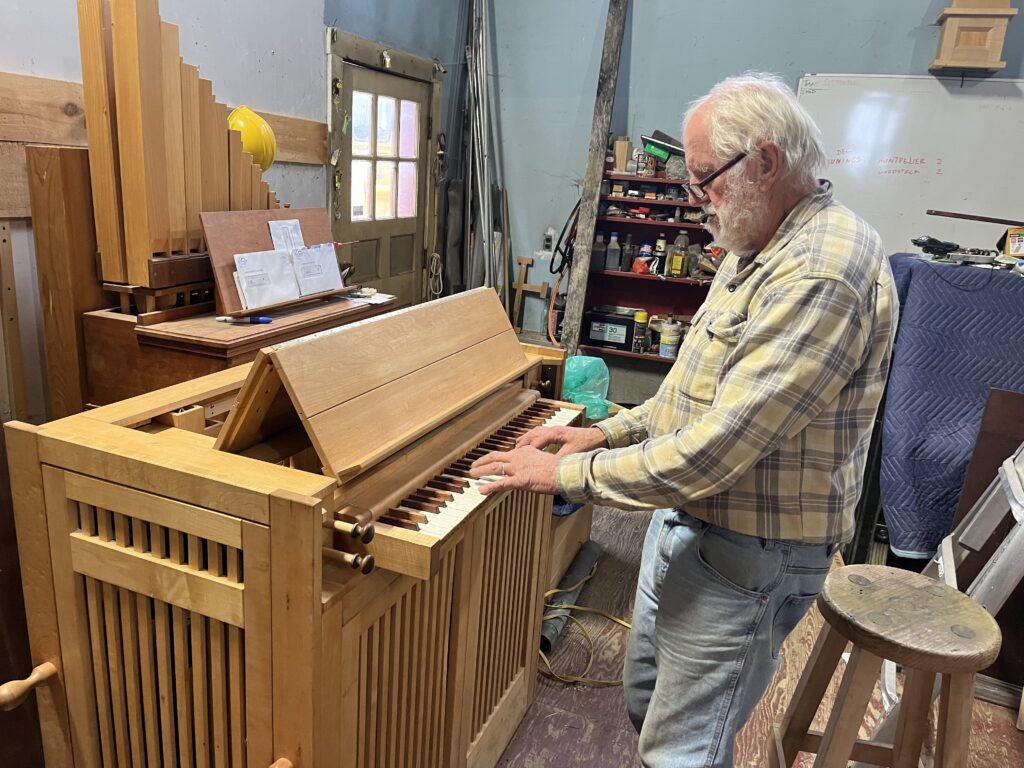
In December of 2022, David Moore entertained visitors by tickling the ivories on a small, custom-built pipe organ he crafted in his Pomfret workshop. Tom Ayres Photo
Atwood worked with Moore at the Pomfret organ workshop for a time early on and continued to assist him with projects now and then over the years, even as he pursued his own celebrated career as a botanist and orchid specialist, working at the famed Selby Botanical Gardens in Sarasota, Fla. After leaving Florida and returning to Vermont, Atwood returned to working at the Pomfret shop. As a youth, Atwood also joined his friend Moore in pursuing musical interests. “As a teenager, David developed an interest in piano music and studied with [Woodstock Union High School] teacher Beverly Newton, as did I,” Atwood remembered. “I had the piano music bug since age three and the organ bug at age seven — the latter of which infected David at about age 14. During the summer of 1961, we both spent a day per week learning organ, playing basics with Fred Metcalf of the Norwich Congregational Church. Fred was a real Vermonter who also ran a sawmill during the week.”
Moore joined the staff of C.B. Fisk Organs in Massachusetts in 1969 and formed his own company in Pomfret three years later. “Fisk was probably the most progressive organ builder of the 1960s and 1970s,” Atwood opined. “David was offered a partnership by Charles Fisk, but he embarked with his new company instead.” Moore’s lifelong friend suggested that it was David’s love of rural life in Pomfret and his native Vermont that drove him to maintain his nationally renowned organ firm on the multigenerational family farm for well over five decades. “He wanted to stay in his home community. He needed to find something he could do up here,” he offered. “I know that the [company] business manager wanted him to move into an urban place, but that didn’t sit very well with him. And the thing is this: his home place also has plenty of wood, so he bought almost no wood. The only wood he would buy might be a little bit of black walnut,” Atwood noted, relating that Moore would harvest, hew, and mill the wood he needed to reconstruct or build new organ cases from timber he found on his family farmstead.
That affinity for home, hearth, and the fields and woodlands of the Green Mountain State extended to the many employees, apprentices, and students David Moore mentored over the years. Bowen worked with Moore for “about 40 years,” much of that time as the master organ minder’s shop foreman. “I had worked elsewhere, basically in woodworking and antique repair, and some of my friends had worked with David at some point,” Bowen remembered during a phone conversation with the Standard last weekend. “I reached out and went into the shop — and he hired me then and there. He employed a lot of people from Pomfret and Woodstock and the general area. My initial role was just as an employee, but then I became foreman, so I was involved in the design, teardown, and reconstruction [of organs] — pretty much everything from that point on.”
Bowen reflected on what it was like to work under his longtime employer’s tutelage. “David was unique in that he went about his own kind of rules — he kind of went with the flow, but with his own rules and his own principles to it,” the shop foreman at Moore’s company noted. “He was pretty much friends with everybody. He would show you how to do things, but he would definitely invite your criticism, too. But oftentimes he stuck pretty close to what he thought was going on.” A magnanimous soul, Moore connected appealingly with everyone he encountered. “He fit in with everybody. It didn’t matter whether you came from rags or riches or were from the country club or the mechanic’s shop,” Bowen enthused.
In a memorial he drafted for the regional and national organ-building community and shared with the Standard, Gnodde spoke glowingly of his friend and mentor Moore, with whom the accomplished organist served as an apprentice for eight years, beginning in 2009. Gnodde subsequently founded his own successful organ repair and restoration business, now based on Webster Hill Road in South Pomfret. Together, he and Bowen are working to fulfill the A. Moore Pipe Organ Company’s few outstanding contracts. Fittingly, Gnodde is currently working in his own shop on a new restoration and reassembly of the Masonic Hall organ that Moore and Atwood first saved from the scrap heap 60-plus years ago.
“When we moved from Amsterdam, the Netherlands, to Pomfret in the spring of 2009, I had no clue a pipe organ shop was located five minutes from our house. At that point, I had been working as an organist, and building organs was not something I planned to be involved in,” Gnodde wrote in the memoriam for Moore. “That summer, my wife and I visited the open house at David Moore’s shop, which is located on the Moore family farm, and were happily surprised by the quality of his work. Having been trained playing renowned historic pipe organs, I appreciated the traditional nature and sound of his instruments,” Gnodde added. “Thoroughly fascinated, I asked whether I could apprentice with him. During the next eight years, I learned about every aspect of traditional organ building, from preparing lumber and casting pipe metal sheets to making and voicing organ pipes. David was a great teacher. He would give detailed instructions and explanations, but also gave me freedom to pursue my own ideas. Besides, he was generous, patient and kind.”
Gnodde warmly recollected those years of working alongside Moore, Bowen, and Atwood from 2009 to 2017. “The shop was a lively place full of laughter. I worked alongside Tom Bowen and John Atwood, two longtime employees. David and John’s quibbling was continual and often hilarious,” the veteran organist and instrument repairer noted. “One time I brought in samples from a tree on our property we could not identify, knowing full well this would set off a lengthy, heated argument. They immediately took opposing viewpoints; I sat back and enjoyed the spectacle.” Gnodde added that “besides organ building, David enjoyed gardening, growing trees, and making hard cider, beer and wine — activities that often would spill over into the shop.”
The Organs of a Lifetime
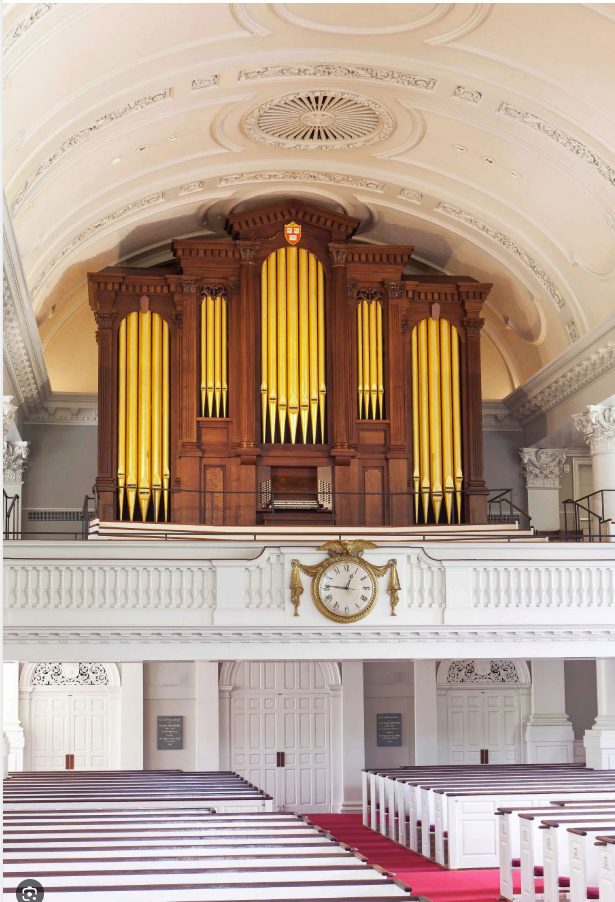
The restoration and rebuilding of the Colonial-era pipe organ at the historic Old North Church in Boston was completed by David Moore in 1991-92. Organ aficionados and historians consider the restoration work performed by Moore and his organ rehabilitation team to be one of the most significant musical instrument preservation efforts of the 20th Century. Courtesy of Old North Church
Atwood, Bowen, Gnodde and Moore’s son, Christopher, all assisted in compiling an annotated list of the many organs on which Moore and his Pomfret-based crews worked over the years. The compendium of the dozens of instruments the revered organ minder built, rebuilt or repaired for churches, colleges, and private homes throughout the United States over nearly six decades is astounding.
Here in the local area, visitors to St. James Episcopal Church, the North Universalist Chapel Society, and Our Lady of the Snows in Woodstock and the United Methodist Parish and St. Mary’s Episcopal Church in Northfield can revel in the sounds of Moore’s handiwork on pipe organs he rebuilt or maintained in those sacred edifices. (In October of last year, North Chapel hosted a commemorative recital by organist Abraham David Ross, marking the 150th anniversary of the installation of the sanctuary’s Thayer Organ, which Moore permanently repaired in 2008 using locally harvested and milled basswood, among other native materials.) The mellifluous sounds of Moore’s handiwork also resonate through the hallowed spaces of the Grace Episcopal Church in the Georgetown section of Washington, D.C., and St. Paul Catholic Church in Pensacola, Fla. The original pipes of the organ in Florida came from an instrument Moore rescued from the St. Catherine of Siena Catholic Church in the Charlestown section of Boston when that church closed in the early 2000s. Moore built a completely new “tracker” organ around the historic pipework created by Moritz Baumgarten, a prominent Boston organ builder of the mid-19th Century.
It’s in Boston, moreover, that perhaps Moore’s most celebrated accomplishment as an organ builder and restorer can be found and heard: the Colonial-era pipe organ at the historic Old North Church of Paul Revere and “One if by land, two if by sea” fame. The major restoration and reconstruction of the Old North Church organ, which dates back to 1759, was carried out by Moore and his crew in 1990 and 1991. The project entailed preserving and restoring the original Thomas Johnson organ case from the mid-18th Century, retaining surviving pipework and other historic components of the instrument, reconstructing the mechanical actions of the organ “tracker” and keyboard, and designing and building new pipework where original material had been lost — a process that was based on careful study of surviving English and American-built organs of the mid-to-late 1700s. In documents now archived in the Smithsonian Institution in Washington, D.C., organ scholar and historian John Fesperman detailed the techniques and expertise Moore brought to the Old North Church project, calling the effort “one of the country’s most important examples of historically informed organ restoration.”
To hear a sampling of music played on the Old North Church organ, along with a discussion of the instrument’s history by church music director and organist Libor Dudas, visit youtube.com/watch.