By Emma Stanton, Staff Writer
Earlier this month, the Center for Research on Vermont at the University of Vermont Alumni House honored Woodstock native Howard Coffin with its 2026 Lifetime Achievement Award.
The Lifetime Achievement Award recognizes individuals who have made outstanding contributions to the state of Vermont and to its people. Recipients are researchers, government leaders, community leaders, teachers, artists, and historians who have had enduring, significant, and positive influences on the state. Holly Painter, the center’s director, spoke to the Standard this week about why Coffin was chosen to receive the award.
“This award belongs to those who are true experts in their field. Howard not only can recount something substantive about the wartime experiences in each Green Mountain town and village, but he also has written expertly about the history that shaped our nation. It is not simply his ability with the written word but the way he captivates a crowd that made him a prime recipient of this award. Howard has exposed so many people in this state to the rich history of Vermont; it was an honor to give him the Lifetime Achievement Award.”
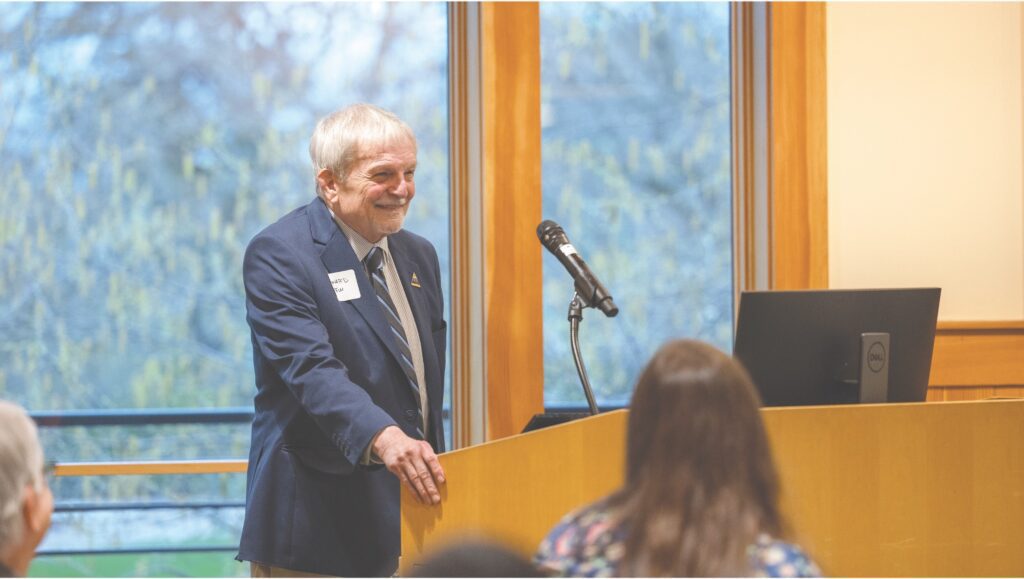
On May 5, Howard Coffin was awarded the Lifetime Achievement Award by the University of Vermont. Courtesy of Holly Painter
Coffin talked with the Standard this week about his distinguished career.
“I grew up in Woodstock. My lineage goes back quite a few generations in that area. My grandmother Coffin had a book full of old Civil War pictures. When I was a child, on a rainy day in Woodstock, when there was nothing else to do, we’d go through the photographs and see what that part of history looked like.”
“This was when I was three or four years old,” Coffin added. “My mother remembered her grandfather, who had fought in the Civil War — so between hearing stories about him and looking at the picture book, I was hooked on the Civil War before I even knew it.”
What started as a childhood obsession soon grew into a lifelong dedication. Coffin is a self-taught historian, as he told the Standard. “I was a college dropout and never went back to finish my degree. I was drafted into the army and spent a couple of years serving through 1966, when I took a job at the Rutland Herald. I took a year off to go down south and prowl around the battlefields and teach myself about the Civil War. I read and read and read everything I could get my hands on about that era of history.”
When asked how the Civil War held Coffin’s attention for years, he credits his mother’s storytelling. “My mother was a fantastic storyteller,” Coffin said. “She knew how to make history come to life. Then, when I was 25, I spent two weeks in Virginia at an Army summer camp during which I took a trip to the countryside. I stumbled on a Civil War battlefield, and there was a church there that had been in the middle of the fighting. I came around the corner of the church, and there were bullet holes in the bricks. I’ll never forget putting my hand into those holes made by those bullets all those years ago. It was like I felt something pull me in. To know that I was actually touching a piece of history, I knew I’d be hooked on this subject for the rest of my life.”
Coffin has authored four books on the Civil War, nine total, with a specific focus on Vermont and exploring the rich history of the war as it relates to the Green Mountain State.
Coffin described his seamless transition from reading to writing. He said, “Writing was a hobby in the beginning. In 1967, when I was 25 and had begun traveling and learning and collecting more and more information on the war, I didn’t once think about writing. I didn’t finish my first book until I was about 50 years old. There were 25 years of reading and exploring battlefields year after year. After reading hundreds of books on the subject, I suppose in my 40’s I began to think that I should write one of my own.
“I was working as a press secretary for Senator Jim Jeffords, and I decided that I was going to quit and write books. I went to Countryman Press, which was located right here in Woodstock. I didn’t know anybody or anything about writing a book. I just called up the editor. He took me out to lunch, and after hearing my pitch, he said if I wrote the book, he’d publish it. I was off and running, and that was nine books ago.”
Coffin says that writing has made him dig even deeper into history. As a newspaperman for 12 years, Coffin had a nose for truth and accuracy above all else.
In searching for credible facts to fill his books, Coffin discovered that the only place to truly find them was on the battlefield. “I began walking each battlefield across the country hundreds and hundreds of times over, each time finding something different to pull at or explore,” Coffin said.
Soon, Coffin began giving tours of these battlefields and other Civil War spots he found through his research. “I’ve also probably given over 1,200 speeches in Vermont alone, and many more outside of the state,” Coffin said.
“I was terrified of public speaking when I was a kid, even through high school and college. But after my first book came out, I was in such demand to speak. I made myself do it and do it well. I decided on the way to my first big event to rip up my notes and throw them out the window. I conquered my fear that day and have enjoyed public speaking ever since.
“I think it is the only way to keep history alive – sharing it with others, taking them along the journey of our nation, through each tumultuous battle and glorious victory,” Coffin added.
After decades dedicated to the history of the Civil War, countless speeches told and battlefields visited, one moment in particular still sticks out to Coffin. “I was very interested in Gettysburg. You could make a case that Vermont won the Battle of Gettysburg by defeating Pickett’s Charge, but the more I studied Vermont Civil War history, the more convinced I became that Vermont’s great moment in the Civil War happened on May 5, 1864, in a battle called ‘The Wilderness.’
“Now very interestingly, and these things seem to happen to me all the time — when UVM gave me this award, the ceremony was held on May 5, 162 years after ‘The Wilderness,’” Coffin said.
He explained, “It was one of the biggest battles in the Civil War. It was two days long, and the Vermonters got called to defend the crossroads in the middle of a jungle-like woods. In the afternoon of May 5, they lost 1,000 men and saved the army of the Potomac — the big Union Army — from being cut in two.
“The army went on to win the most important campaign of the Civil War. No state lost as heavily as Vermont did on a per-capita basis on that afternoon in May.”
Coffin went on to write a book about this battle called “The Battered Stars: One State’s Civil War Ordeal During Grant’s Overland Campaign.” He’d go on to tour the battlefield in Virginia — all 500 acres – and worked with Senator Jeffords to preserve the land for others to appreciate for years to come.
On a concluding note, Coffin said, “I was a failed student of UVM. I never finished my degree; I have been a self-taught historian all my life. To be recognized by this university, on this day — it’s an accomplishment I never thought I’d achieve. I cannot wait to continue giving tours and talks about the subject that has captivated me all my life. What an honor and a privilege.”
Coffin will be speaking at the Bridgewater Historical Society at 2 p.m. on June 7 on Vermont’s General Grant. For more information on Coffin’s speeches and written works, visit: vermonthumanities.org