By Justin Bigos, Staff Writer
If you’ve got enough rizz to eat gyoza during mud season, you have likely made at least one local man’s job feel rewarding. Windsor resident Michael Metivier, who works at Merriam-Webster as a lexicographer — by definition, a person who writes and edits dictionary definitions — wrote the dictionary’s entries for “rizz,” “gyoza,” and “mud season,” all of which entered the 12th print edition of the Merriam-Webster Collegiate Dictionary in November 2025, the first fully revised collegiate edition in over 20 years.
Metivier was recently a guest speaker at the Hartland Community Resilience (HCR) Saturday morning breakfast series, where he spoke to over 50 people in attendance, according to HCR’s Andy Kelley. “It went very well,” Kelley told the Standard. “It was a snowy morning, and in spite of all that, we got quite a good crowd.” He recalled Metivier showing a definition from an older dictionary in order to show how objectivity was not always a goal in lexicography. “He showed a definition of ‘cat,’ and clearly the person that had written the definition didn’t like cats,” said Kelley.
In fact, the word the dictionary used to describe cats — written by Noah Webster himself — was “deceitful,” according to Metivier.
“I write a lot of slang [word definitions], and I have defined some of these newer words, or when there’s a new sense of a word that has emerged,” Metivier told the Standard this week. “Something like ‘mud season’ has been around for a really long time, right? But the reason why it may not have been entered in dictionaries past is because before the advent of the internet — which has more or less unlimited space for entries — dictionary editors had to be very judicious about what takes up space within a physical dictionary. If there [is] a new edition of a dictionary and you put a lot of words in, including compound words like ‘mud season’ that could be considered self-explanatory, you’re going to also have to make room for them by taking words out.”
Other newer entries in Merriam-Webster that Metivier has written include “burrata,” “popcorn” as an adjective — think popcorn shrimp or popcorn chicken — “settler colonialism,” and “systemic racism.” A word that has been added to Merriam-Webster’s online dictionary as an article, but does not yet appear in print as a definition, is the ubiquitous tween/teen slang term “six/seven.”
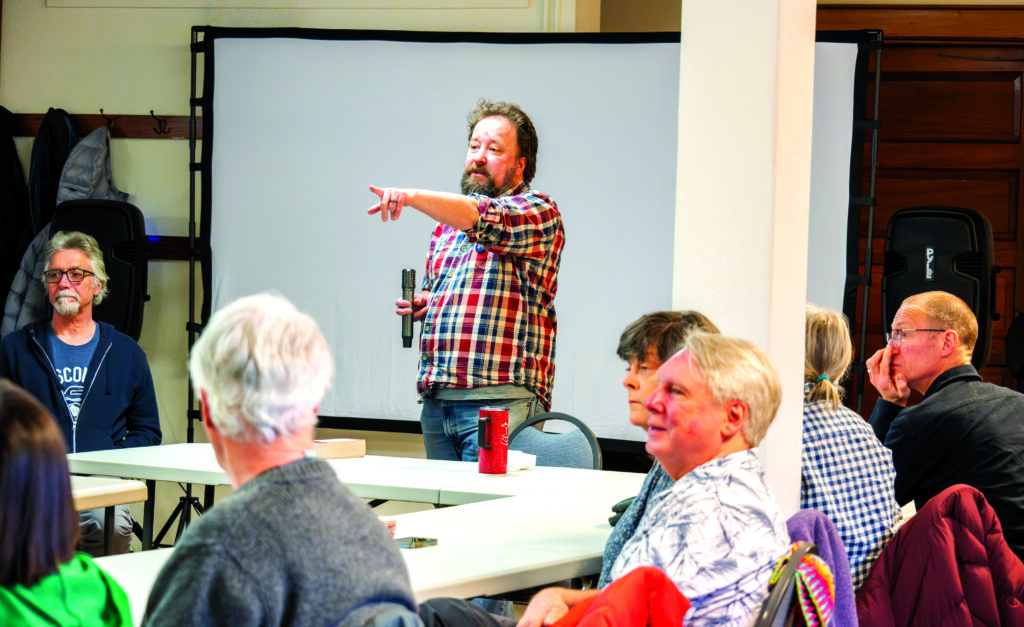
Michael Metivier calls on someone asking a question during the Q&A portion of his presentation at the Hartland Community Resilience breakfast last week.
Pamela R. White Photo
“There are some words that I personally don’t like,” said Metivier. “‘Six/seven’ isn’t one of them, but in terms of that type of almost moral judgment [against new slang], I don’t necessarily see it. My job isn’t to make judgments like that.”
“Merriam-Webster is known as a descriptivist dictionary,” he explained. “Other dictionaries may have different criteria, different styles of how their entries are written, and different purposes. Merriam-Webster is a descriptivist dictionary in that it is trying to record how people actually use language, and not to say that something should or shouldn’t be a word that people use.”
It is that democratic spirit, in which all are welcome to contribute words to a living language, which can paradoxically irk people who view dictionaries — if not the English language itself — as only suitable for words and phrases that have a solid history beneath them, don’t sound vulgar (“vulgar,” of course, can simply mean “common”), or have grammatically correct usage. But at what point can one say “I am going to lay down (vs. ‘lie down’), irregardless what anyone thinks about my grammar?”
“‘Irregardless’ is a word that a lot of people vocally despise,” said Metivier. “[A dictionary] might label a word like that as nonstandard, and have a note that explains that if you do use it in edited prose, your editor might object. But that word has been around for hundreds of years with a meaning that is understandable and consistent, and it has been used in lots of different contexts, legal contexts, all sorts of ways.” In other words, perception of a word’s legitimacy may not match its actual history of usage.
“There are other words that people have strong feelings about because of what they represent, like ‘systemic racism’ or ‘fascism,’ which is looked up a lot. Writing or revising those entries is not about providing encyclopedic information, but accurately identifying what people are referring to when they use those words,” said Metivier of his job, as well as that of the team of editors he works with at Merriam-Webster. “It all comes from a lot of reading, and not just by me. Every entry is worked on by many people to make sure that we get it right, and to make sure that we’re not injecting personal bias into things.”
Metivier’s fascination with words and language is not unsurprising, considering that he is also a poet. Having published his poetry in magazines such as The Kenyon Review and Orion, he is putting together his first full-length collection of poetry. “I feel like writing a dictionary entry is very similar to writing a poem, and also like solving a puzzle. Sometimes writing a poem feels like solving a puzzle. If you’re working within a form in poetry, you’ve got some kind of formal constraint, and you’re trying to express something that may be ineffable, as closely as you can,” he said.
“Dictionaries are ultimately going to be imperfect,” said Metivier. “We’re trying to be as accurate as possible in describing how language is used. But how a word is used is like a big fuzzy cloud, right? We’re trying to consolidate that as much as possible, but language is too big and unwieldy and wonderful and wild and always changing to ever get it perfect.”