By Armita Mirkarimi, Staff Writer
“I saw our old ones dancing on that space,” Earl Hatley recalled of the moment eight years ago when he first set foot on what was then the unused Quechee polo field. “I watched them for a while, and then they all turned and looked at me and smiled, and I promised them we would dance here again. The garden project is that dance.”
Today, Hatley tends rows of corn, beans, and squash on that same field where he witnessed his vision. The traditional Three Sisters plants grow in carefully constructed mounds, their intertwined roots and vines creating the agricultural partnerships that have sustained Indigenous communities for thousands of years. The polo field is now a working garden that feeds Abenaki families while teaching ancient agricultural wisdom to a new generation of Vermont farmers. This Saturday, Aug. 30, there will be an open house at the gardens, showcasing the full scope of traditional agricultural knowledge while welcoming community members into ongoing cultural exchange.
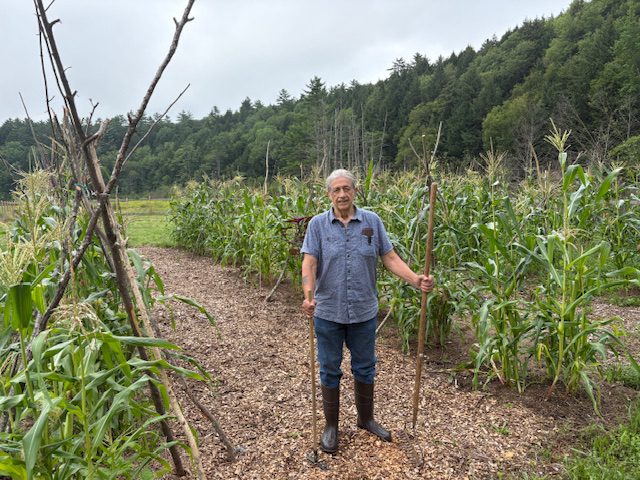
Earl Hatley stands among the towering corn stalks in the Abenaki Three Sisters Garden, where traditional agricultural methods have produced a thriving harvest in the garden’s growing season. Courtesy of Lynn Luczkow
Born and raised on the Cherokee Reservation in Oklahoma before becoming an enrolled member of Vermont’s Missisquoi band of the Abenaki people, Hartford resident Earl Hatley understood that meaningful change requires more than good intentions. When he joined the Quechee Lakes Landowners Association’s Diversity, Equity and Inclusion Council five years ago, he brought with him both agricultural expertise and a crucial message about the difference between words and action.
The breakthrough came when the association asked Hatley to write their land acknowledgment statement. After completing the task, Hatley challenged the Indigenous partnership: “Now those are just words. They don’t mean anything, unless your actions also back it up.”
Lynn Luczkowski, who chaired the Diversity, Equity, and Inclusion Council during those pivotal discussions, remembered the moment as transformative. “Earl had a vision, and he always thought that teaching people the historical perspective of Native American agriculture was a really important piece, just based on our history and how a lot of things have gotten lost,” Luczkowski told the Standard.
What followed was three years of careful negotiation between Hatley’s newly formed nonprofit, the Ottauquechee Water Protectors Association, and the landowners association. The complexity of securing a land use agreement for the one-acre space adjacent to the polo field marsh tested everyone’s commitment to turning acknowledgment into action.
The garden that emerged reflected sophisticated agricultural knowledge developed over millennia. Four rows run precisely east to west, ensuring even sun exposure throughout the day. Each row spans three feet in width with nine feet between them, measurements that accommodate both traditional planting methods and modern maintenance needs.
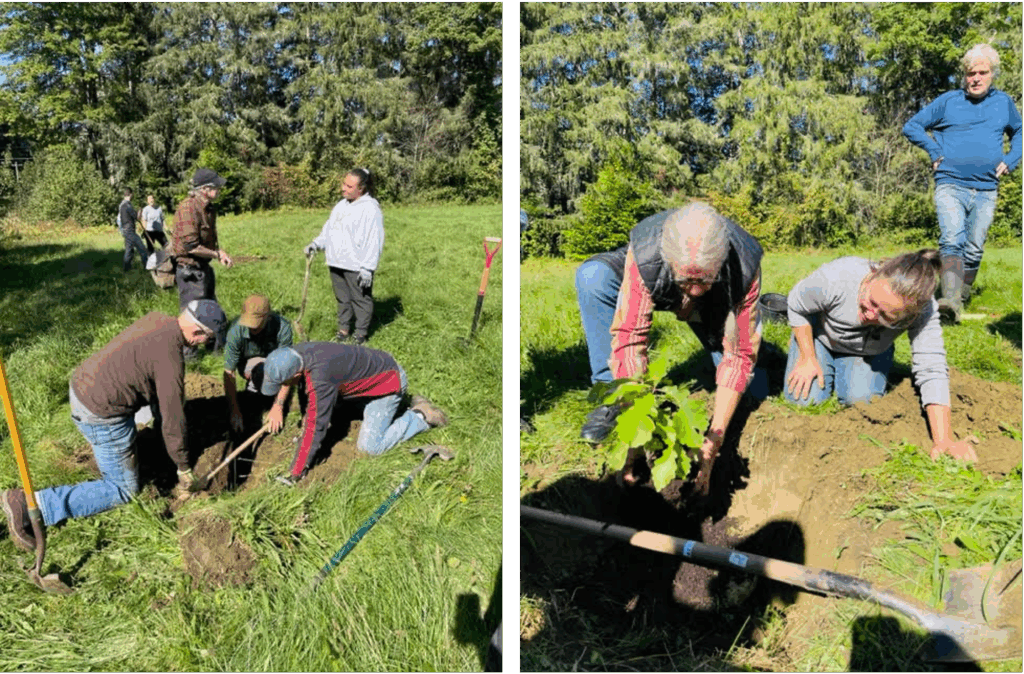
Left, community members dig post holes during the garden’s development, part of the extensive infrastructure work needed to establish the fenced growing space on the former Quechee polo field. Right, volunteers work together planting in the Three Sisters Garden, demonstrating the community collaboration that makes the project possible through regular work days throughout the growing season. Courtesy of Lynn Luczkowski
At the heart of each planting mound lie seven corn seeds, arranged according to spiritual principles that predate European colonization by thousands of years. “Seven is a sacred number for us,” Hatley explained. “We believe there are seven directions: the four cardinal directions and then up to the sky, down to the earth, and within our hearts.”
The Three Sisters themselves — corn, beans, and squash — represent more than companionate planting. Recent scientific research confirms what Indigenous peoples have long understood: these plants don’t merely coexist, they “chemically work with each other to ward off pests,” Hatley noted.
Beyond the central Three Sisters plantings, the garden showcases a broader range of agriculture: elderberries, white oaks, butternuts, wild plums, ground nuts, gourds, ground cherries, sunflowers, and Jerusalem artichokes. This “food forest,” as Hatley called it, functions as an edible riparian buffer while preserving genetic diversity of plants that sustained Indigenous communities through countless climate variations.
The 2024 growing season proved the garden’s practical value alongside its cultural significance. From their carefully tended acre, volunteers harvested enough produce to feed approximately 15 families in the Upper Valley. The surplus was divided between food pantries operated by the Koasek band and Missisquoi band, contributing to efforts that serve hundreds of additional families across Vermont’s Abenaki communities.
But the garden’s impact extends beyond immediate food security. Hatley’s mission includes building seed stocks of traditional cultivars, plants that have adapted to New England’s climate variations over thousands of years. “These seeds have been through all the climate changes for thousands of years,” he emphasized. “If any seeds can survive what’s coming, it would be seeds like this.”
The educational component transforms every volunteer day into a cultural exchange. Students from Dartmouth College and the University of Vermont regularly join work sessions, learning traditional agricultural methods while contributing labor. The community gatherings that follow work days — featuring shared meals and storytelling — create connections that transcend the garden’s fence line.
Heidi Schultz, a DEI Council member deeply involved in the project’s development, recalled the basic challenges that urban visitors might not consider. “It’s been so hard to get the fence in,” she laughed, describing two years of hand labor before the landowners association provided heavy equipment to dig post holes and complete the enclosure. “That was great, because, my God, it probably would have taken us forever.”
The infrastructure challenges highlighted the collaborative nature that makes the garden possible. Brian Kelly, general manager of the Quechee Club, provided crucial institutional support throughout the development process. “He really was very, very involved and instrumental from the club side,” Luczkowski noted, crediting Kelly’s engagement as essential to overcoming bureaucratic hurdles.
For council members like Schultz, the garden represents more than successful collaboration — it challenges assumptions about Indigenous presence in contemporary Vermont. “The more I learn about the Abenaki people in Vermont, who by the way are unrecognized by the federal government, which is horrifying to me,” she reflected, “the thing that’s important to keep in mind is that they have been caretakers of the land here in the Upper Valley for thousands of years.”
That federal non-recognition creates ongoing challenges for Abenaki communities, limiting access to resources available to federally recognized tribes. Projects like the Three Sisters Garden provide both practical support and crucial visibility for Indigenous peoples who, as Hatley emphasized, “have always been here, and we’re still here.”
The educational mission extends beyond agricultural techniques to fundamental questions about land stewardship and cultural continuity. “People think they’re not here anymore,” Schultz observed, “but it’s present history too. They’re making history now.”
Presentations at the open house will explain the scientific basis for Three Sisters planting alongside its spiritual significance. Demonstrations will illustrate traditional mound construction and the sacred seven-seed planting method. A video presentation will document the garden’s development from Hatley’s initial vision to this year’s growing season.
Most importantly, visitors will experience the community atmosphere that transforms agricultural work into a cultural celebration. Regular volunteer days combine garden maintenance with shared meals, creating what participants describe as authentic brotherhood and sisterhood focused on collective benefit rather than individual gain. “There’s like a community, sisterhood, brotherhood feel of people working towards something that isn’t necessarily going in your pocket,” Luczkowski explained, describing the atmosphere that draws volunteers from across Vermont. “It’s not a tomato or a squash that you’re going to eat, but you know that it’s going to go in the right hands.”
As the garden enters its full growing season, Hatley’s vision encompasses expansion beyond current boundaries. Plans include fall plantings of pawpaws and additional food forest species, gradually building the ecological complexity that characterized pre-colonial landscapes. The seed-saving mission continues building genetic resources for future generations while providing immediate sustenance for Abenaki families.
For supporters seeking involvement beyond Saturday’s open house, opportunities abound through the Ottauquechee Water Protectors Association. The organization’s website at abenakigarden.org provides volunteer signup forms and donation options, while regular work days offer hands-on learning experiences in traditional agriculture.
The garden’s success has attracted attention from Vermont’s Indigenous community and agricultural organizations alike, positioning it as a model for similar projects throughout the region. But for Hatley, the broader implications remain secondary to the fundamental promise that started everything. “The Abenaki are still here, and we’re strong,” he stated. “You just don’t see us that much. But a project like this brings it out.”
The open house Saturday morning will bring visitors to the former polo field where Earl Hatley first encountered his vision eight years ago. They’ll see the results of that promise: corn growing in traditional mounds alongside beans and squash, demonstrating agricultural methods that have sustained Indigenous communities for millennia while adapting to modern growing conditions.
The work that began with Earl’s vision continues through regular volunteer days, seasonal harvests, and the ongoing effort to preserve traditional seeds for future generations. Saturday’s open house offers the community a chance to understand this work firsthand and discover how they might contribute to its continuation.