By Justin Bigos, Staff Writer
“All I wanted to do when I was growing up here was leave,” Stockbridge native Kevin Chap told the Standard this week as he traced the early arc of his life journey that eventually returned him to the rugged hills, valleys, and streams he had roamed and foraged in his youth. After college in Baltimore, postgraduate studies, and 10 years working in the New York City film industry, Chap returned to his hometown of Stockbridge. Seven years later, PBS Vermont took his show about food and habitat, and how to “rewild” our food systems — also known as agroecology. In April 2026, the series “Wild Foods” will debut on PBS VT and be distributed nationally.
“When I left New York, most of my friends thought I was crazy,” said Chap. “They’re like, ‘You have a lucrative career in the film business. Most people would kill for that.’ And I’m like, ‘It just wasn’t enough.’” Back in Vermont, Chap had taken a job with the Youth Conservation Corps, and the Marsh-Billings-Rockefeller National Historic Park in Woodstock, teaching outdoor education and environmental science. He started making videos of fishing, foraging, and cooking — and after sending some clips to a friend at PBS, the idea for the show was born.
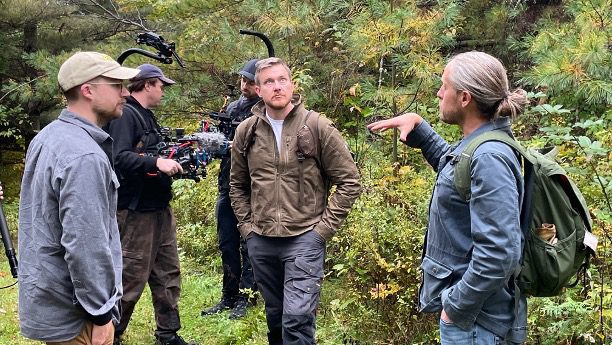
Filmmaker Kevin Chap (middle) talks with Ryan Christiansen of Caledonia Spirits (right) and Tyler Tronson (left) while they forage juniper berries in Bakersfield, on the set of Chap’s show “Wild Foods.”Courtesy of Thom McKenna
Half of the show’s first eight episodes are centered in Vermont. “One of the exciting things about the show is that Vermont features as kind of a central character. We don’t exclusively stay in Vermont — we travel all throughout the country — and our hope is to go international with the show. [But] we’re always going to return home to Vermont, because I find it a super hopeful landscape, especially in these very turbulent times. There’s a reasonability, there’s an accountability, there’s a proximity to nature,” said Chap.
The pilot episode, “The Golden Hills, Vermont,” takes the viewer to Chap’s home in the Chateauguay wilderness, where he forages for wild mushrooms such as Chicken of the Woods and Hen of the Woods, and where he cooks Lion’s Mane crab cakes. Guests include chefs at the Dorset Inn, his uncle Peter, and members of the Abenaki Nation, who discuss the importance of integrating wild foods into sustainable farming and how reintroducing native seeds can help fight off climate change.
“I told a lot of important stories — foundational stories — in our pilot, and it was also Vermont-centric,” said Chap. “It was really building on these much bigger themes about our food system, and really what’s happening with our food. I think [we] Americans have a very low food IQ, and we’re blessed here in Vermont because we have the highest concentration of local foods in our food system, organic foods in our food system, and wild foods in our food system.”
Chap stressed that, amid all the problems in agribusiness and the broader corporate food system, his show is not out to stir up negativity and pessimism. “Through our pilot, we’re really focused on success. We want to celebrate success and not point fingers and not blame people, because this is a problem that we all deal with every day. It’s no one person’s fault that our food system is not providing us with healthy, wholesome, and regenerative foods that can be good for the environment, good for Main Street, good for the farmer, and healthy for us,” he said.
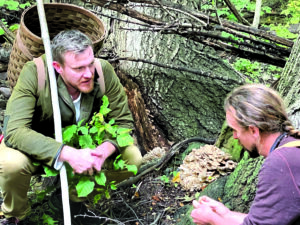
Chap (left) and John Hunt (right), an Abenaki skills instructor and agroforestry expert, forage hen-of-the-woods mushrooms in Shelburne on the set of the show. Courtesy of Thom McKenna
Native perspectives are central to “Wild Foods,” said Chap, and the Abenaki are not the only indigenous tribe whose stories and wisdoms are shared on the show. “The show ‘Wild Foods’ cannot exist without tapping into that ancient wisdom that is held by our indigenous, First Nations peoples. And I’ve been very lucky to work with some amazing folks, from Chief Don Stevens with the Nulhagan [Band of the Coosuk — Abenaki Nation], to the Passamaquoddy, to the Hopi people, the Salish, the Chippewa Cree out in Montana, [and] with the Haudenosaunee, Mohawk, and Oneida.”
One of the distinctive qualities and approaches to “Wild Foods” is Chap’s deliberate creation of “unscripted time for play.” These spaces provided some of his favorite moments in the season. One example took place in the Big Apple. “In New York City just last month, I was taking folks through Central Park, and showing that [wild foods] exist in the largest city in the country. We actually found maitake mushrooms in the Sheep Meadow, growing on an English oak. We didn’t harvest (you’re not supposed to harvest in Central Park), but [we did this] to show the nation that wild foods — even if you live in an urban environment— are still prolific.”
In this same episode — the seventh of the season, “New York — New Amsterdam” — the viewers get to meet Chef Michael Anthony, executive chef of the world-renowned Gramercy Tavern. “Talk about a chef with no ego, but really focused on knowing his growers,” said Chap. “He’s spent a decade or more getting to know his farmers up and down the Hudson Valley and within a 200-mile radius, so that he knows them by a first-name basis. To see a chef on that level of success doing things with food that are really cutting edge and really amazing, but having that intimate relationship with his suppliers, is really an inspiration to me. That’s what I mean by working with people who are doing it well, doing it right. No matter how big they get, they still understand that the best they can do with their food programs is to get the best ingredients. If more chefs and more consumers thought that way, boy, I think we could have a massive impact on our food system and our relationship with the natural world.”
The final episode of “Wild Foods” ends in Vermont, with a yuletide feast, featuring many of the wild foods collected by Chap on his show’s journey across the country. Viewers are given a recipe guide to follow along at home with Chap and famous chefs as they make holiday meals from wild ingredients. Chap felt the show needed to end in Vermont — right where it began. “The show would not exist without the support of folks from the Upper Valley. The special topography of the Upper Valley features heavily in the show, especially the pilot, where we take the audience out to the No-town Chateauguay, a good slice of wild land between Stockbridge, Barnard, Killington, and Pittsfield. This really is where our story begins. The Ottauquechee Two Rivers Commission (in Woodstock) has been tirelessly working to conserve as much of this land as possible, along with Vermont State Lands and Northeast Wilderness Trust.”
Vermonters and anyone who cares about land, food, and each other can catch the show’s premiere on PBS in April 2026. More info can be found at www.wildfoodsnetwork.com.