By Justin Bigos, Vermont Standard Staff Writer
“Ansel Adams said a good photograph is knowing where to stand,” Caleb Kenna told the Standard this week, in discussing his new photography exhibit at Billings Farm & Museum. “I think that sort of applies to both portraits — when you’re right up close with someone — and with drone aerial photography.”
Kenna’s exhibit, “Our Working Lands: Photography by Caleb Kenna,” which just opened on Jan. 10, features a purposeful combination of aerial drone shots of Vermont’s richly varied topography along with striking portraits of the people who call Vermont home. What may appear a surface contradiction in both vantage and technique instead offers an artistic vision fusing nature and human, the wild and the built — and attendees will be able to gaze at this carefully curated ode to the Green Mountain State for the next six months.
Kenna, raised in Brandon and currently residing in Middlebury with his family, told the Standard that his formative inspiration came from the newspaper business — where he worked as a photojournalist, including at the Rutland Herald and Addison Independent. “As a photographer, I would often be asked to look for ‘wild art’ [coined in this context by his editor at the Herald], which is that standalone photo that tells a story. When I was working at newspapers, because there’s not a lot of hard news in Vermont, I would do that, and that’s sort of ingrained into the way I work. I’ve carried that over into the aerial photography, looking for ‘wild art,’” said Kenna.
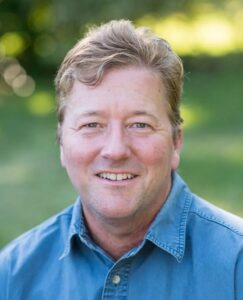
Kenna
In the aerial photos, viewers can make out various regions and terrains of Vermont — from dairy and solar farms to autumn vineyards to winter lakes that look like shattered, frosted glass. A noticeable quality of the aerial views is their appearance as abstract art, in the way they tease the brain with mesmerizing patterns and fractal-like geometries. “When I go out, I’m looking for great light, for patterns that maybe elevate the scene,” said Kenna. “This can be very mundane, to something that’s a little more interesting and more abstract. The drone is incredible for creating compositions where every inch of the frame matters. You can go up and down, left and right, up to 400 feet, and create images that really hold together compositionally. I’m inspired by that more abstract quality, and I think those are the ones that work best.”
Seeing a landscape we know so intimately from the ground in such a distant, abstract way from above can reorient — even disorient — the eye of the viewer. Kenna says this is no accident. “The way that we installed the exhibition, the photos have a lot of space, so I think they really reveal themselves differently from different distances from the viewer,” said Sherlock Terry, curatorial and exhibits manager at Billings Farm & Museum. “They really draw you in, and you almost have to get right up on the photo to figure out what it is — even at the same time, when you stand 20 or 30 feet back, there’s a [larger] composition. They really invite close looking.”
At least one of the photos in the exhibition may be recognizable to viewers from the Upper Valley. In an aerial photo of the vineyard Domaine La Garagista, titled “Fall Vineyard, Barnard, Vermont,” the view is ruddy and autumnal. “One of the things that the show emphasizes is the seasonality of working with the landscape,” said Terry. “The photo from the Domain La Garagista is in the fall, and it’s kind of amazing. I’m assuming they’re aspen or poplar [trees] that have that really saturated bright yellow. You can see the lines of some of the vines and some other crops. And it’s just a very abstract and colorful composition. It really shows some of the texture and also the nuance and the color of that kind of time of fall.”
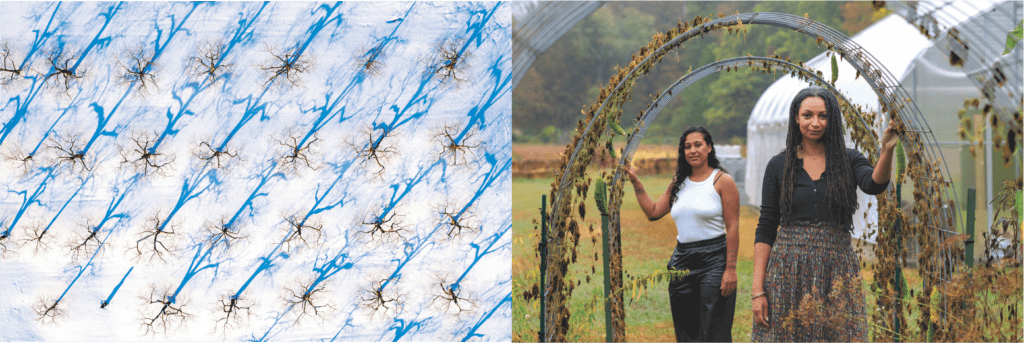
Left: The photo “Cornwall, VT.” At Right, a portrait of Amber Arnold and Naomi Doe Moody, co-founders and collaborative directors of the Afro-indigenous SUSU commUNITY farm in Newfane, are among several portraits of Vermont workers and farmers represented in the show. Courtesy of Billings Farm & Museum
In collaboration with Terry, part of the curatorial process was Kenna occasionally adding portraiture to pair with some of the aerial photos he’d already taken. “The way the show is organized, it’s one big wall of about 18 portraits, and those portraits have been taken over several years,” said Kenna. “Some were taken this year because I had aerial photos of certain places, and I needed to go back and create portraits — for instance, of the serpentine quarry in Rochester. I had photographed that incredible quarry for a while, and then I went back and photographed the owner and his son working in the quarry, sort of complementing the coverage.”
Along with the portrait of the son and father working their quarry in Rochester, other portraits include a photograph of Deidre Heekin, co-director of the La Garagista vineyard, in which she peeks through the bramble of harvest-ripe grapes and reaches for a golden, sun-dappled bunch. Another portrait at the show features Amber Arnold and Naomi Doe Moody, co-founders and collaborative directors of the Afro-indigenous SUSU commUNITY farm in Newfane, which is “committed to centering food and land sovereignty through educational opportunities, land-based relationships, and ancestral healing,” according to the farm’s website. In the photo, Arnold and Moody are framed by an arbor grown wild with green and bronze leaves seemingly caught between seasons.
Kenna says he has done a lot of work with the Vermont Land Trust, which has helped him explore the state and its landscapes and people, as well as more deeply appreciate the need to conserve our land. “We do have such incredible, beautiful landscapes that we need to protect them. And there are so many fascinating people working the land. I wanted to pay tribute to them and to the landscape in this show. It’s been a lot of fun just to get to know some new people and look back and kind of see patterns in my own work, which is basically people in the land interacting.”
“I hope they just have fun looking at photos and seeing places in a new light, and maybe even seeing their friends or neighbors on the wall,” said Kenna of those who will visit Billings to see his show over the next six months. He added, “And I’m looking forward to inviting all the subjects themselves to a [more ceremonial] opening, which [is] to be announced.”